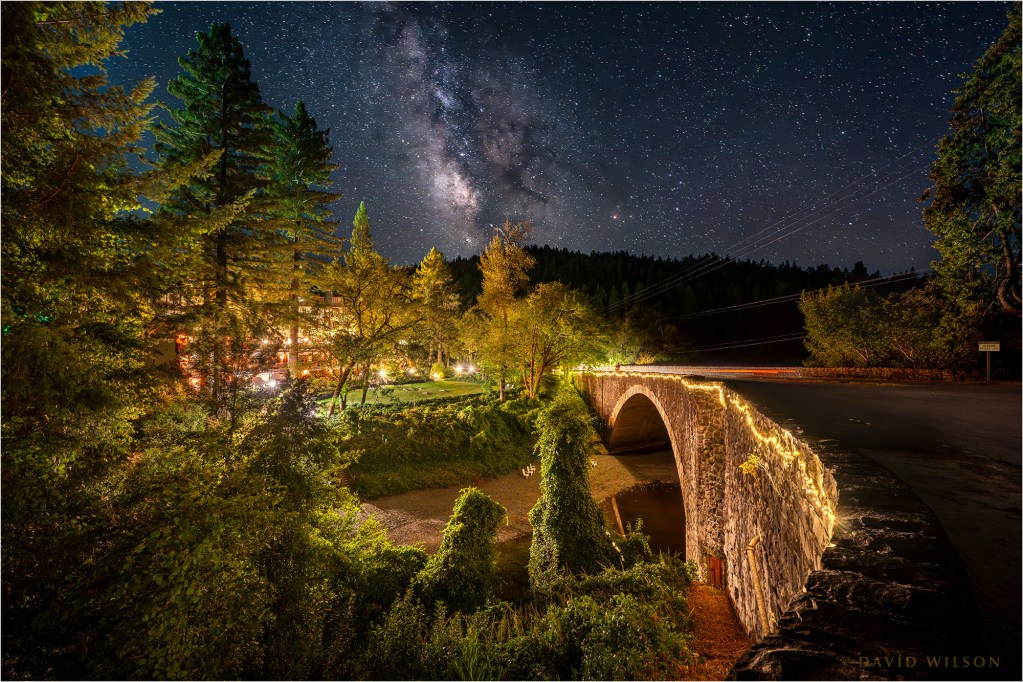
A historic Humboldt County landmark glows beneath the Milky Way on a clear August night.
The historic Benbow Inn keeps quiet watch along the South Fork Eel River, a century-old host lit in gold while the stars swing silently across the sky each night. In summertime, the Milky Way takes its turn, marking time as it sweeps by like a clock hand through the night. I traveled down there the other night to catch them all together: the Inn, the Milky Way, the bridge and river. They were all there waiting for me.
Scouting out the scene
I had scouted the scene a couple weeks previously while staying at the Inn with family. It was a wonderful stay. The timing was off with the night sky, though, as the moon was sitting on the Milky Way, completely blotting it out in moon glow. I didn’t want the moon for this one, but I knew that in two weeks it would come up late enough to leave me with a sky dark enough for the Milky Way’s display. So I scouted the place for angles with my brother and nephew in anticipation of a return.
I wanted a composition with good light and good lines that also had the Inn, the bridge, and the Milky Way in it. While scouting the area, I noticed something I’d never seen before — a small wooden door tucked into the base of the bridge across from the Inn. I didn’t know what it was for, and still don’t, but I assumed it concealed some kind of bridge troll. I knew right then I’d want it in my shot.
My app told me where the Milky Way would be in a couple weeks after dark, and when the moon would rise. It was a matter of finding an angle that gave me as much visual goodness as possible. Never mind that the Inn isn’t actually visible; its golden glow is what makes the foreground magic work. I hadn’t realized that the Inn’s lighting would be so perfectly illuminate my foreground, even highlighting the texture of the stone Benbow Bridge.
On August 13 it all came together, and my brother and I headed down to try making the photo (it’s never a sure thing). Without him, I probably wouldn’t have gone down that night, so thank you, bro!
Speaking of bridges, a nearby photo expedition found me out Late One Night at Cooks Valley Bridge (search for “bridge” on this site to find other stories of Humboldt bridges beneath the stars).
Technical details
This is no simple snapshot. For those interested in some technical details, read on.
What complicated making this image was that the scene had a much wider dynamic range (the range of values from the brightest highlights to the deepest shadows) than my camera could capture in a single frame. If I were to take a single photograph, it would yield either a well-lit foreground with an underexposed sky, or a good sky with a completely overexposed foreground; I would not be able to get the balanced exposure you see here.
The solution was to take a series of photographs. I first photographed for the brightest lights so that they looked normally bright, not overexposed. The next exposure was a little brighter in order to start gathering shadow detail. I took a series of 6 or 7 photos, each one successively brighter until in the final one, I had the shadow detail I wanted.
Then in the computer I combined them all using a process called HDR editing (high dynamic range), which is the process of gathering the image information from each of the photographs in the series and creating a single image that had everything exposed well from the highlights to the shadows.

The photographic process for taking this kind of night image is different from normal photography, where moving the camera between shots is natural. For this, I could not move the camera from beginning to end — once I settled on a composition, I had to leave the camera in place. Everything has to line up exactly the same in each shot or else combining the images doesn’t work. I needed to leave the camera in one spot for hours to capture this.
And thus my brother and I sat with the camera from dusk until 11:00 pm, getting hungry and munching cookies while I made many separate series of images as the light changed and the Milky Way crawled across the sky from left to right (one has to shoot a lot if one wants to get the best shot possible, something I tell my students all the time). It turned out that the last series of photos I took were the money shots; it was darker for better stars, the Milky Way had moved into a better position, the focus was good, it all worked.
A take away: don’t simply take a single photo and be done with it. You have no options with a single photo. But if you take a bunch of photos, you can choose from among them — one of them will be the best. And think: if you had only taken one photograph, what are the chances it would have been the best one of ten? Exactly one in ten, and that’s poor odds.
The photo forces, or gods, call them what you will, were good to me that night. Capturing the historic Benbow Inn beneath the Milky Way has been in my thoughts for a long time. Finally last week, the little voice that says, “If you don’t go out, you won’t bring anything back,” got its message though and we took the trek.
It took perseverance and shooting that sequence of photos many times to finally get the one I wanted, (much as it did capturing Comet NEOWISE Over California’s North Coast), but the wait, the trek, and the work paid off: the Inn’s glow, the Milky Way, the bridge… even a mysterious door — all there in one frame at last.
Humboldt stories about that Benbow Bridge door
Since posting this, I’ve heard some stories about that door.
One commenter on the Redheaded Blackbelt post told of a time when she’d gone through that door for an explore some time ago… no trolls to report, though, she said.
Then my stepmom’s husband told me about a guy whom many of us from Southern Humboldt probably know who would go in there to collect bat quano for his plants! (How’s that for a Humboldt story!) I forgot to ask whether he’d said anything about trolls.
If you have a story about that door, I’d love to hear. And if it’s ok, I’d include it here.



Your Comment is Welcome